

How To Keyword Search On Windows
Keyword search
Keyword search (or SQL index search) is Relativity's default search engine. Yous can use a keyword search to query a full text index. The long text and stock-still-length text fields included in this alphabetize vary by workspace.
Note: New workspaces created in RelativityOne have extracted text automatically stored in Data Grid. Workspaces restored into RelativityOne using the ARM application will automatically take the extracted text migrated to Information Grid. In guild to search extracted text in workspaces, you lot must use dtSearch or Analytics searching; you cannot use Keyword Search.
Yous can use Boolean operators (AND, OR, NOT) in keyword searches, besides as quotation marks for verbal matches, asterisks (*) for wildcards, and other features. However, if you perform a keyword search with multiple terms, documents where those terms exist in separate fields won't return.
Notation: If y'all want to draft queries outside of Relativity, use a plain text editor such every bit Microsoft Notepad to prevent adding characters or formatting that might render unexpected search results.
While the keyword search offers fewer options than other Relativity searches, it uses an index that's automatically populated, reducing maintenance and ensuring all required certificate fields are indexed.
Note: For information on configuring and managing word breakers, go here.
This folio contains the post-obit sections:
- Example keyword search strings
- Using the Not operator in keyword searches
- Understanding stop words
- Running a keyword search
Fields
A keyword search alphabetize is available in the Search Indexes tab by default. Click the Keyword Search link.
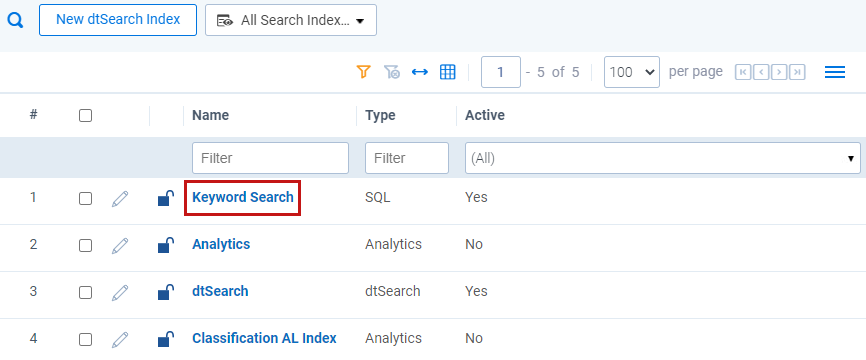
The keyword search index details page contains the following fields:
- Proper name- the proper name of the keyword search index. The name is the display name for the index.
- Order - a number that represents the position of the index in the list. The everyman-numbered index will exist at the peak. The highest-numbered alphabetize is at the bottom. Items that share the aforementioned value are sorted in alphanumeric gild. Index guild tin be whatever integer (positive or negative). No decimals are allowed.
- Active - determines whether the alphabetize should be activated or deactivated. Yes ways that the alphabetize will exist activated; No means that the alphabetize will exist deactivated.
Note: If yous apply item-level security to a search index, users can't run any public saved searches built on that index and will get an mistake. We recommend leaving the index unsecured and instead applying security to the Search indexes tab or to individual saved searches.
Instance keyword search strings
The post-obit table lists search cord examples with their expected results.
| Search cord | Returns documents with... |
|---|---|
| wired | the give-and-take wired |
| wired magazine | the words wired and magazine |
| wired AND magazine | the words wired and mag |
| wired OR magazine | the discussion wired or the word mag |
| wired, magazine | the word wired or the word magazine |
| "wired magazine" | the exact phrase wired magazine |
| wired NOT magazine | the word wired and not the word magazine Notation: Do not commencement key word searches with the NOT operator, or employ it with the OR operator. For case, these searches are invalid:
|
| wire* | any words beginning with wire, such as wired, wires, wireless Notation: Fundamental give-and-take searches do not support the employ of wildcards at the get-go of a word. (Keyword searches are SQL index searches run on the Microsoft SQL Server, which does not back up leading wildcards in total text searches.) |
| figurer AND (wired OR mag) | the word computer and the word wired OR the word estimator and the word magazine Note: When a search string does not include parentheses, the club of precedence for a keyword search evaluates AND then OR expressions. For example, the search cord A AND B OR C is evaluated every bit (A AND B) OR C. |
Note: Search terms with absolute messages are recognized and return keyword search results.
Using the Non operator in keyword searches
When running a keyword search that is an SQL total text search, advisedly format queries that utilize the NOT operator. For example, yous may want to query for email messages that take Ryan as the author, just do not have Will as the recipient. The fields in the following record are included in the index used to demonstrate how this query is run:
| Document | OCR | Recipient | Writer |
|---|---|---|---|
| AS00001 | From: Ryan To: Volition | Will | Ryan |
A keyword search using the string Ryan NOT Volition returns the certificate AS00001 even though yous would non expect it in the effect prepare. The post-obit table illustrates the SQL logic used to evaluate the query Ryan NOT Will.
| SQL queries this field... | Returns these results... |
|---|---|
| OCR Field | Finds both Ryan and Will, then no certificate is returned. |
| Recipient Field | Does not find Ryan, so no document is returned. |
| Author Field | Finds Ryan only not Volition, so the document AS00001 is returned. |
When these fields are searched using the SQL logic, the Writer field matches the query Ryan Non Will, and unexpectedly returns the document.
Notation: Y'all tin can utilize the AND Not operator in a dtSearch as an culling arroyo to this type of keyword search.
Understanding stop words
Stop words in a keyword search include punctuation marks, single letters, single digits, and words such as "at", "a", "on" and "the".
Keyword search stop words - without double quotes
Stop words used in Keyword searches are ignored if the search string is non surrounded past double quotes. In a search for the phrase lord's day on my head, both on and my are ignored. The result is that the words sun AND head are queried without respect to proximity. Thus, any documents that contain both the words sun and head will exist returned.
The following table illustrates how Keyword search queries for phrases that contain terminate words that are not surrounded by double quotes.
| Searching cord (without quotes) | Queries for this string |
|---|---|
| dominicus on my caput | sunday AND caput |
| lord's day on head | dominicus AND head |
Keyword search terminate words - with double quotes
If a Keyword search string containing stop words is surrounded past double quotes, and so the stop words' positions in the string are taken into account when the query is executed. Nevertheless, only the positions of whatever intervening cease words are taken into account, not the stop words themselves. End words at the kickoff or tail end of a Keyword search string are ignored.
For case, the search strings "sun on my head" and "sun my on head" (where on and my are switched) return the same records. This is considering Keyword search evaluates both search strings as a query for the phrase sun ABC XYZ head, where ABC and XYZ represent any two words, non just end words. Similarly, a query for the search string "dominicus on head" returns documents that contain the phrase sun ABC caput, where ABC represents any discussion.
The following table illustrates how Keyword search queries for phrases that contain stop words, and that are surrounded past double quotes.
| Searching string (with quotes) | Queries for this string |
|---|---|
| "sun on my caput" | dominicus [AnyWord] [AnyWord] head |
| "lord's day on head" | sun [AnyWord] caput |
| "dominicus on my head and" | dominicus [AnyWord] [AnyWord] head |
| "and dominicus on head" | sun [AnyWord] caput |
Unmarried digits every bit stop words
Single digits 0-nine are default stop words, so y'all cannot query on them with a keyword search. Relativity doesn't render the expected results if you attempt to query on a single digit. Use the dtSearch feature to query on a specific number or letter.
Nonetheless, you lot can employ a keyword search to query on whole numbers greater than nine. You can search on more than one digit, such as 09. While these digits may be used to represent a specific numeric value (such as 9), they are non considered single digits, and tin can exist used in a keyword search.
Punctuation every bit end words
Sure punctuation marks are treated equally stop words by default, and so you lot cannot query on them with a keyword search. They include:
- Catamenia (.)
- Colon (:)
- Semicolon (;)
- Slash (\,/)
At sign (@) and dashes
The at sign (@) and dashes (-) are ignored from existence indexed in a keyword search, when either is used at the beginning of a query. For instance, if you search a domain proper noun, the same number of documents return whether you lot include or exclude @.
Hyphens and dashes
When a search phrase includes a hyphen or dash, the query returns results that include terms containing other punctuation marks. For example, the following results return for a search on the term Pop-upward:
- Pop.up
- Pop--upwardly
Default stop word list
Relativity comes with the post-obit default stop words:
| Begins with... | Stop words |
|---|---|
| A | about, after, all, besides, some other, any, are, as, at |
| B | exist, because, been, earlier, being, between, but, both, by |
| C | came, can, come, could |
| D | did, exercise, does |
| Eastward | each, else |
| F | for, from |
| G | get, got |
| H | has, had, he, take, her, here, him, himself, his, how |
| I | if, in, into, is, it, its |
| J | just |
| L | like |
| Yard | make, many, me, might, more, well-nigh, much, must, my |
| N | never, no, at present |
| O | of, on, only, other, our, out |
| S | said, same, see, should, since, so, some, still, such |
| T | have, than, that, the, their, them, then, there, these, they, this, those, through, to, besides |
| U | under, upwardly, use |
| Five | very |
| W | desire, was, way, we, well, were, what, when, where, which, while, who, will, with, would |
| Y | you, your |
Running a keyword search
Running a keyword search in the search panel
Use the following steps to run a keyword search in the Search panel.
- Navigate to the Search console in the Documents Tab.
- Click Add Condition.
- Select (Index Search) in the Add Condition drib-down menu. The (Alphabetize Search) window opens.
- Select Keyword Search from the drop-downwards Index.
- Enter terms for the search in the Search Terms box.
- Optionally, select the Sort By Rankoption to return results in gild by relevance. The most relevant documents are listed at the top of the result set.
- Click Apply.
- (Optional) Add together any additional atmospheric condition through the Add Condition drop-down menu.
- Click Run Search. To end a long running search, click Cancel.
Running a keyword search in the Search browser
Utilize the following steps to run a keyword search in the Search browser.
- Click
 to admission the search browser from the document list.
 - Click New Search.
- Set required fields.
- Click Add Condition.
- Select (Index Search) in the Add together Condition drop-down menu. The (Index Search) window opens.
- Select Keyword Search from the Index drop-down menu.
- Enter terms for the search in the Search Terms box.
- Optionally, select the Sort By Rankoption to render results in order by relevance. The nigh relevant documents are listed at the top of the outcome set.
- Click Employ.
- (Optional) Add together whatsoever additional conditions through the Add together Status drop-down menu.
- Click Save or Save As.
- Click the name of the keyword search in the search browser.
- Click Run Search. To stop a long running search, click Cancel.
Source: https://help.relativity.com/RelativityOne/Content/Relativity/Keyword_search.htm
Posted by: ruizthatimbers.blogspot.com
0 Response to "How To Keyword Search On Windows"
Post a Comment